

•ether.fi
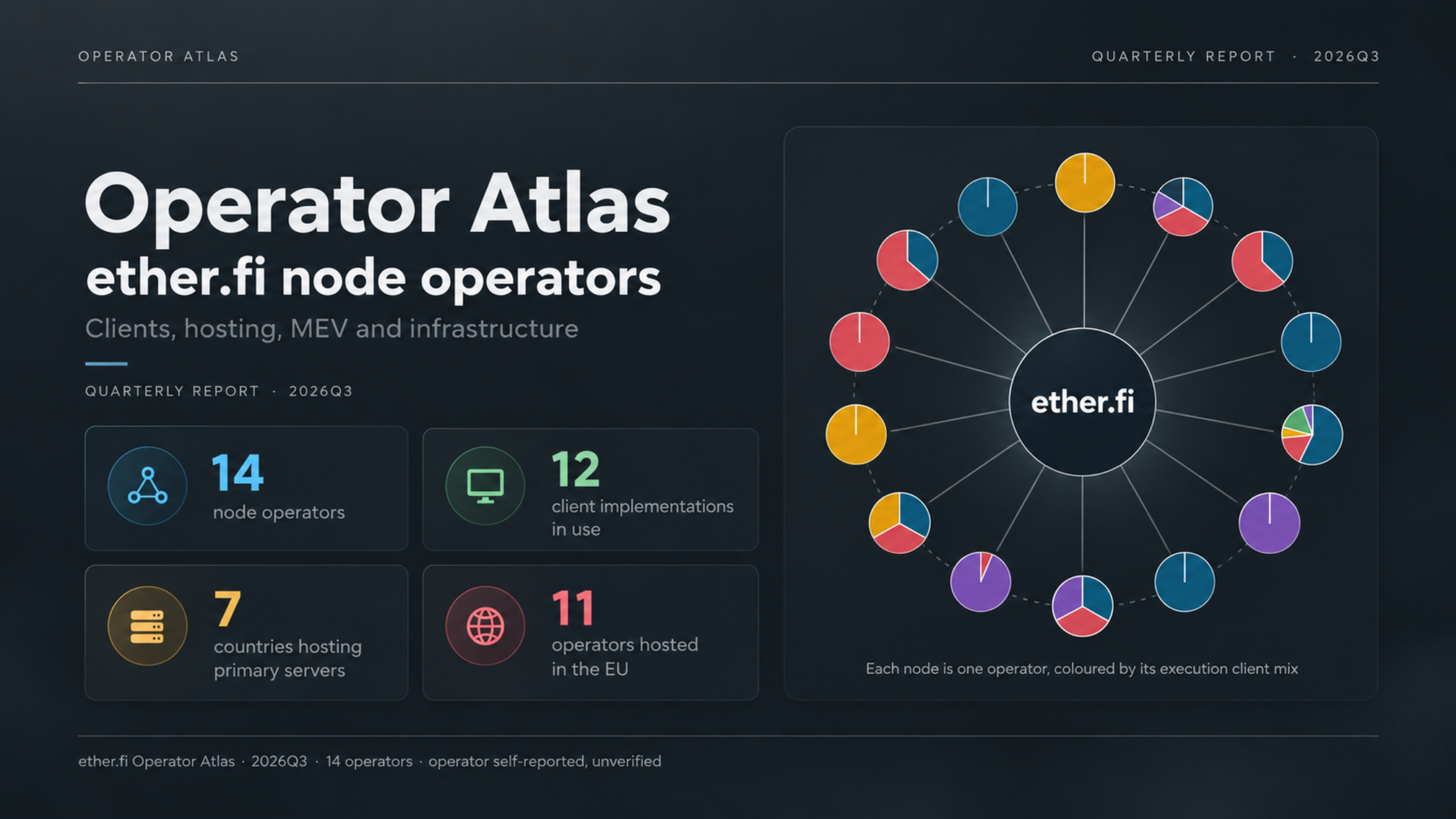
The first ether.fi Operator Atlas: which clients our 14 node operators run, who uses DVT, where their servers sit and how they set up MEV.
ETH staked through ether.fi runs on validators operated by independent node operators. How those operators build and run their infrastructure decides how safe, reliable and decentralized the staking is. This is the first Operator Atlas for ether.fi. It shows which clients the operators run, whether they use distributed validator technology (DVT), where their servers sit and how they set up MEV. We work with the operators on an ongoing basis to improve their infrastructure and security.
Here is the short version. Five of 14 operators run SSV for some or all of their ether.fi stake, and none run Obol. Eleven of 14 operators have their primary servers in the EU, and five of them share one hosting provider, OVH. Geth and Lighthouse are the most used clients, and no client runs more than half of the estimated stake. Eight operators run commit-boost for MEV, and four already run the Optimum gateway.
The Operator Atlas is a regular public report on the node operators behind ether.fi staking. Each edition covers the same topics, so readers can compare quarters and compare operators.
Client diversity matters because a bug in one widely used Ethereum client can hit every validator that runs it. Hosting and MEV choices matter because they affect uptime, censorship resistance and the rewards validators earn.
Fourteen node operators answered the 2026Q3 questionnaire between 25 September and 16 October 2026: NodeMonster, P2P.org, Finoa, HashKey Cloud, Ebunker, DSRV, Stakefish, Luganodes, Validation Cloud, Chainnodes, Stakin, Allnodes, Twinstake and InfStones.
Every validator needs three pieces of software: an execution client, a consensus client and a validator client. Running a mix of clients across operators limits the damage from a bug in any one of them.
Geth and Nethermind lead at an estimated 38.1% and 24.8%. Reth (17.7%) and Besu (17.0%) follow, and Erigon and Ethrex each appear at one operator. Nine operators use Geth and eight use Nethermind. Seven operators send all of their stake through a single execution client, and three of them (HashKey Cloud, Stakefish and InfStones) run 100% Geth.
Lighthouse holds an estimated 38.1% across 10 operators. Teku (26.3%) and Prysm (23.2%) follow, then Nimbus (9.9%). Seven operators run one consensus client for all of their stake.
Teku and Lighthouse are the main validator clients outside DVT. SSV carries an estimated 30.3% across five operators, and Twinstake runs Vouch, a multi-client validator setup.
DVT splits a validator key across several operators so no single machine holds the whole key. Five operators run SSV: P2P.org, HashKey Cloud and Ebunker at 100% of their stake, and Finoa and DSRV at 51-75%. No operator reports an Obol Charon share. HashKey Cloud selected "Both Obol and SSV" on the DVT question but reported 0% Charon, which we are confirming with them.
Two operators changed their setup this quarter. InfStones moved from SSV to native staking on Geth and Prysm, and DSRV moved its SSV operators from Nethermind to Reth on 20 July.
Eight operators run on bare metal for 76% or more of their stake. Three (DSRV, Twinstake and InfStones) run entirely on public cloud, two run a cloud-majority mix and one splits evenly between cloud and bare metal. Eleven of 14 operators have their primary servers in an EU country, led by Germany (4) and France (3).
OVH hosts five operators, and Latitude.sh, CherryServers and AWS each host three. One OVH incident would touch five operators at once.
MEV software sits between a validator and the relays that sell block space. Operators choose which relays to connect to, how long to wait for a bid, and whether to build a block locally instead.
Nine operators use OFAC-filtering relays, and two of them do so because of regulation. Two operators mix filtering and non-filtering relays, and three use non-filtering relays only. Every operator runs the same relay set on all of its ether.fi validators. Only two operators set a min-bid (0.01-0.02 ETH). Four operators still list the bloXroute Max Profit relay, which bloXroute sunset on 26 August.
Eight operators run commit-boost, five run mev-boost and one runs Vouch. Commit-boost versions range from 0.9.2 to 0.10.1. Two operators run mev-boost 1.10.1, behind the 1.12 line the other mev-boost operators run. Four operators run the Optimum gateway.
Ten operators call relays for a header at the start of the slot. Two wait up to 500 ms. One starts at 100 ms and polls every 100 ms, with late_in_slot_time_ms at 2000, and one reports adaptive timing per slot. Most operators reported timing as categories, so the chart uses exact numbers only where an operator gave them.
We work with our node operators on an ongoing basis to improve their infrastructure and security. The Operator Atlas gives us and each operator a shared picture of where things stand today, so we can focus that work on the areas that matter most.
Fourteen operators reported for 2026Q3: NodeMonster, P2P.org, Finoa, HashKey Cloud, Ebunker, DSRV, Stakefish, Luganodes, Validation Cloud, Chainnodes, Stakin, Allnodes, Twinstake and InfStones.
Partly. Five of 14 operators run SSV for some or all of their ether.fi stake. No operator reports an Obol Charon share, and nine operators use no DVT.
Geth is the most used execution client (nine operators, an estimated 38.1% of stake) and Lighthouse is the most used consensus client (ten operators, an estimated 38.1%). No client is above 50% on an equal-operator basis.
Eleven of 14 operators have their primary servers in the EU, led by Germany and France. Eight operators run mainly on bare metal and five share OVH as a provider.
Nine operators use OFAC-filtering relays, two mix filtering and non-filtering relays, and three use non-filtering relays only. Two of the nine use filtering relays because of regulation.
Eight operators run commit-boost, five run mev-boost and one runs Vouch. Four operators also run the Optimum gateway.
We work with them on an ongoing basis to improve their infrastructure and security.
No. Operators reported it themselves, and share figures are bands converted to estimates. Each operator confirms the data shown for it before this report is published.